Highlights
-
- Stronger alignment between finance and program teams helps nonprofits make more informed decisions.
-
- Connected systems reduce reporting delays and make financial visibility easier across the organization.
-
- Cloud accounting platforms help simplify grant tracking, forecasting, and day-to-day reporting.
-
- Better access to shared information helps everyone stay focused on the mission instead of figuring out reporting and process issues.
-
- Real-time financial visibility supports faster, better planning and more proactive operational decisions.
Stronger nonprofit finance and program alignment helps organizations stay focused on the mission instead of chasing spreadsheets and disconnected reports.
Nonprofits are expected to move fast while managing limited resources and responding to growing pressure to demonstrate impact. At the same time, finance, operations, and program teams often work from different systems and different reporting processes, which can make alignment harder than it should be.
Better coordination between finance and program teams supports more informed decisions without adding unnecessary complexity to day-to-day operations. In many cases, cloud accounting tools make that process much easier.
In this article, we explore four practical ways nonprofit finance and program alignment can help organizations operate more efficiently and stay focused on their mission.
1. Better visibility leads to better decisions.
One of the biggest challenges nonprofits run into is that different program teams often operate with very different information.
Program leaders usually have a strong understanding of community needs and day-to-day priorities but may not have easy access to real-time financial data. Meanwhile, finance teams are managing budgets, grants, compliance requirements, and reporting while trying to keep pace with changing program demands.
That gap can quickly create frustration. It also makes decision-making harder than it needs to be.
When financial and operational information is easier to access across the organization, conversations become more productive. Instead of piecing together spreadsheets and manually rebuilding reports, everyone has a clearer picture of what’s happening and where resources are going.
2. Financial reporting should support strategy, not create delays.
Manual reporting processes can slow everything down, especially when leadership needs quick answers around budgets, grants, staffing, or program performance. By the time reports are finalized, the conversation may have already moved on.
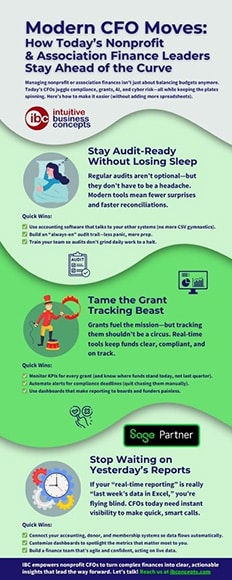
Cloud accounting systems help simplify that process by centralizing financial information and making reporting easier to manage across different programs. Instead of pulling data from multiple systems and rebuilding reports manually, it becomes much easier to access clearer insights and more reliable grant tracking with far less administrative effort.
Solutions like Sage Intacct are one example of how nonprofits are modernizing financial management to support better reporting, stronger visibility, and more informed operational decisions.
3. Connected systems help finance and program teams stay in sync.
Finance and program teams are ultimately working toward the same mission, but they often operate with very different information.
Program teams focus on service delivery and outcomes. Finance teams focus on budgets, compliance, forecasting, and reporting. Without connected systems and clear communication, those priorities can gradually drift apart.
That disconnect often affects:
-
- Budget planning
-
- Grant management
-
- Resource allocation
-
- Performance metrics
-
- Forecasting
-
- Long-term operational planning
Improving alignment doesn’t mean adding more meetings or complicated approval processes. It usually means creating clearer workflows and giving teams access to better shared information.
4. Cloud accounting supports nonprofit growth more effectively.
What works for a smaller nonprofit eventually starts getting harder to manage as programs, funding sources, and reporting requirements become more complex. According to CDH CPAs, cloud accounting platforms can help improve reporting efficiency, grant management, and financial transparency. (Source: CDH CPAs, Transforming Nonprofit Finance Management with Sage Intacct)
Cloud accounting platforms help reduce a lot of that operational friction by improving financial visibility and cutting back on manual administrative work. That can lead to:
-
- Better financial reporting
-
- More accurate forecasting
-
- Stronger grant tracking
-
- Faster audit preparation
-
- Better long-term planning
More importantly, it allows staff to spend less time managing disconnected systems and more time focusing on the mission itself.
Sometimes the biggest improvement is simply giving people clearer information and better tools to work with.
Frequently Asked Questions
1. Why is nonprofit finance and program alignment important?
Nonprofit finance and program alignment helps organizations connect budgeting, reporting, and operational decisions to mission goals. Strong alignment improves visibility across programs, supports better decision-making, and helps nonprofits manage growth more effectively.
2. How can cloud accounting improve collaboration?
Cloud accounting platforms give teams access to centralized, real-time financial information. This improves reporting visibility, reduces manual work, and helps program teams make decisions using consistent data.
3. What are the benefits of stronger financial visibility?
Better insights help organizations improve resource allocation, support strategic planning, monitor program performance, and respond more quickly to operational or financial changes.
4. What should nonprofits look for in a financial management system?
Nonprofit organizations should look for systems that improve reporting efficiency, support grant and fund tracking, integrate across programs, and scale alongside organizational growth.
5. When should a nonprofit upgrade its financial systems?
Many nonprofits begin exploring new financial systems when reporting becomes too manual, grant tracking gets difficult, or when leadership lacks clear visibility into financial and program performance. Growing organizations often need more flexibility, automation, and real-time reporting than older systems can provide.
Is your financial data helping or holding you back? If reporting feels harder than it should, it may be time for a better system. At Intuitive Business Concepts, we help nonprofits simplify financial management, improve visibility, and make reporting easier to manage. Contact us today to get started.
About IBC: At IBC, we have a deep understanding of the critical business needs and processes specific to associations, non-profits, and unions. We ‘get’ your culture, your goals, and what drives you, too. Focused exclusively on and dedicated to delivering the most effective AMS, LMS, and Cloud Financial Software for our clients, we’re well-versed in identifying and applying the integration techniques that will save you time and money. Since 2001, our cutting-edge products, unparalleled responsiveness, and award-winning services have helped organizations like yours increase their operational and financial performance by leveraging best practices and proven solutions. For more information about IBC, please visit the website at www.ibconcepts.com or call 443.603.0215.